Showing posts with label About. Show all posts

Tuesday, August 13, 2013

Natural Healing for Goats

Vitalism

The metaphysical doctrine that living organisms possess a non-physical inner force or energy that gives them the property of life.  Vitalism has a long history in medical philosophies: most traditional healing practices posited that disease results from some imbalance in vital forces.

When I asked one of my mentors and idols what the difference between a Vitalist and a Naturopathy is... she responded with,  "A Vitalist believes that the body was created to function properly and given the right nutrition the body WILL return to health. It is a process of thought and belief more than herbalist or naturopath."


Herbalism

Simplistically, herbalism is the study or use of the medicinal properties of plants for health and healing. Originally, the term herb only applied to non-woody types of plants. Later, it came to be used to refer to any part of any plant used for flavoring or medicine. In the field of complementary and alternative health care, it is now used to mean any plant, in whole or in part, having nutritional and/or medicinal value... individual or combined parts of the plant that may used include: seed, fruit, bark, flower, leaf, stem, or root/rhizome.

As a remedy, a herb  may be used alone, or in combination, working synergistically to enhance each herb's properties. There are multiple ways to dispense herbs: aromatics, decoctions, infusions (hot or cold), juices, liniments, lotions, medicated oils, pills (tablets or capsules), poultices and fomentations, powders, salves and ointments, syrups, teas, tinctures or extracts (alcohol or glycerol bases), and whole herbs (dried or fresh).  The choice of form by the herbalist takes into consideration the nature of the imbalance and the method to best take full advantage of the healing attributes of the specific herb.  To increase effectiveness, herbs may be used both internally and externally.


The use of herbs is to treat the actual cause of the symptoms and not the symptoms themselves.

Cleanse and Nourish

This is another basic understanding of herbalism that I hear and read over and over again as I continue on this path of natural healing; Cleanse and Nourish. In order to naturally heal it is critical that you look at the whole body to restore balance and well being. You cannot just treat the symptoms and expect healing results. All you are doing is masking the true illness or disease when you treat the symptoms.

Herbs for Goats

For the most part, any natural herbal remedy that is used for mankind can be used as well with goats. And while there is no formal schooling for a 'Goat Herbalist' there are a great many herbalists whom have experience with the natural healing of goats. A few of my idols are; Kristie Miller, Tracy Obereck Shiftlett, Christine Abbey, Katherine A. Drovdahl and Pat Coleby. I am very blessed to have a few of my idols as my mentors.  As well, I am blessed that it  there is very little difficulty in finding local or online training to be a human herbalist. And well, since goats have many of the same organs as humans and experience many of the same problems and diseases too, that same education and experience can be applied to my goats within reason. Knowing that there are some differences with specific problems that only goats can present will help me to support my goatlings with natural healing.


Dosaging

There is no prescription tag that comes attached to your herbs... especially those that have been wild-crafted. One of the benefits of herbs is that you cannot typically overdose when using non habit forming and non toxic herbs. A conventional rule of thumb that I've seen here and there to determine herb dosages for goats (and children) is by calculating according the goat's body weight as compared to an adult human's dosage:

                Goat's Weight in Pounds     =    the fraction of the adult human dose to use
                            150 pounds   


Form of HerbGeneral Dosages
Bulk Herbs3-9 grams (1/9 0 1/3 oz)
Teas1 oz herb/1 pint water. Drink 1 c 3 x a day
Tinctures20-60 drops, 3-4 x a day
Capsules2-4 caps, 3-4 x a day
Extracts (Dried Concentrated/Freeze Dried)3-5 grams, 3 x a day
Tablets/CapletsFollow Label Directions
Powdered Herbs1 tsp 3-4 x a day
Standardized ExtractsFollow Label Directions
Syrups1 Tbsp, 3-4 x a day
Compress/Fomentations1-2 x a day for 20-60 minutes
PoulticesReplenish 2-3 x a day for 3 days
Essential OilsAdd 1-2 drops to an oil & apply locally
Salves, Creams, Oils, Sprays, Ointments...As Needed (prn)


Dosing more Specific to our Nigerian Dwarfs 

For my goatlings, they currently get about 1/4 tsp of any powdered/dried/bulk herbs. For extracts, tinctures and essentials Oils, they receive approximately 2-3 drops and no more then 5 drops. Some herbs/blends they only get once a day. For chronic situations, they may get their doses three times a day and in acute situations, they get them every 15 minutes for the first hour and then hourly after that until showing signs of improvement. From there, if holding their own, I will go to every  3-4 hours working our way back to a chronic dosage for approximately 2-3 more days.

The Herbal Parasite Control Formula I use on our critters gets a completely different rule for dosage with animals five (5) pounds or less get 1/16 teaspoon,  then 5# - 10# = 1/8 tsp, 10# - 20#     = 1/4 tsp, 20# - 75#  = 1/2 tsp,75# - 100#  = 3/4 tsp, and 100# - 150# = 1 tsp.   Every additional 50#s add an extra 1/2 tsp


(A work in progress...)


Monday, July 29, 2013

Our Menagerie's Newest Member... Khloe

____________
Nickname: Khloe
Nigerian Dwarf Doe

DOB 04/07/2013
Sire: 
Dam: Parham Farms DT Fudge BonBon
AGS, ADGA, NDGA Registered Nigerian Dwarf


Khloe's Dam

Parham Farms DT Fudge BonBon

Sire:  Agape Oaks GHIR Dark Truffle *S
SS: TX Twin Creeks PKM Ghiradelli *S +B
SD: Agape Oaks Burn Ban 2*M *D AR


Dam: Agape Oaks HF Urchin’s Urchin
DS: Flat Rocks Fire Cracker +S +B
DD: Flat Rocks Urchin 2*M AR

Kidding History:
2013 - Twins: 1 Buck, 1 Doe


 Khloe's Sire
 Jagged Rocks DM Thor

Sire:  Parham Farms GG Desert Moon *S
SS: Agape Oaks FC Gift of Grace *S *B
SD: Agape Oaks CK Pizazz *M *D

Dam: Agape Oaks GL Replica 2*M *D  
DS: Flat Rocks Gem’s Legacy +B
DD: Flat Rocks Mica *M *D


Saturday, May 18, 2013

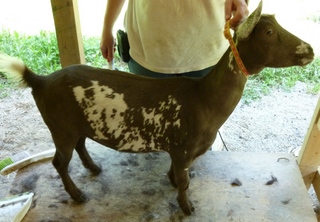
Our Latest Addition to Our Menagerie... Aurora


Aurora
Nigerian Dwarf Doe
DOB 04/01/2013


Aurora's Dam

Chaven Z's "Lady Isable"
Pedigree
AGS, ADGA, NDGA Registered Nigerian Dwarf
DOB 10/15/2008
Sire - Chestnut Grove Lilly's Zorro
Dam - Oldesouth Cassandra Blue
Color - Dark Chocolate with white - w/blue eyes

Aurora's Sire
Critter Kidz "Spotted Cow"
DOB Unknown
AGS, ADGA, NDGA Registered Nigerian Dwarf


Saturday, May 4, 2013

Our Newest Addition to Our Menagerie... Shiva


Shiva Grace
Nigerian Dwarf Doe
DOB 03/18/2013


Sire: JBF C Montague 
  Nigerian Dwarf buck (Blue Eyes)
  DOB 03/04/2012

Grand Sire: Kaapio Acres MH Chipotle
     GSS: Rosasharn SP Manuka Honey (ARMCH Rosasharn SW Sapporo *S'E' x ARMCH Rosasharn's Buckwheat Honey 3*D 'E' 3*M EEEE 91, 2007 AGS National Champion Sr. Doe)
     GSD: Kaapio Acres Quesadilla ( Kaapio Acre's Hot Habanero x Kaapio Acre's BT Rhodora)
Grand Dam: Kaapio Acres Lexus
     GDS: Little Tot's Estate Mazarati
     GDD: Kaapio Acre's BT Rhodora


DAM: JBF N Artemus
     Nigerian Dwarf Doe (Polled)
     Born February 28, 2011


Grand Sire:  Critter Croft (Acres) Neptune
     GSS: Kaapio Acres Hot Estate Bucky
     GSD: Critter Croft (Acres) Mandee's Gem
Grand Dam: JBF NL Munchkin
     GDS: Kiddreamin Noche Luna
     GDD: JBF MHG Narnia's Lucy

Monday, April 1, 2013

Nigerian Dwarf Dairy Goats: History in the Making

Like many breeds of domestic livestock, the history of the Nigerian Dwarf is incomplete. Through the years and stages of development, records were not always kept, or they were sketchy at best. Developing the history of the breed is much like putting together a jigsaw that is missing many of its pieces. To produce the present day Nigerian Dwarf, one has to use a combination of documented facts, speculation, deductive reasoning and a little imagination. What is known is that throughout tropical West Africa, there is a type of goat referred to as the West African Dwarf (WAD). These goats are used as a food source, providing both meat and milk for the local population. Due to economic hardships, keeping “pets” is not an option. It appears that today little thought is used in breeding and a survival-of-the-fittest phenomenon is taking place.

In the writings of Albert Schweitzer a local goat is often times referred to, credited with supplying the milk for the hospital Schweitzer worked at in Lambrene in the country now known as Gabon. The imported breeds, typically known as dairy breeds, weren’t able to withstand the tsetse fly, and therefore were not productive. The WAD goats continued to survive and thrive. Throughout books on Dr. Schweitzer, pictures of goats similar to those referred to as Nigerian Dwarves in the U.S., can be found.


The beginning of the breed in this country lies in zoos. Exactly how the WAD came to American soil is one of the missing pieces in the puzzle. One theory is that as big cats were shipped to zoos, goats were loaded onto the vessels as a food source for the cats while in transit. The goats that weren’t consumed went on to the zoos. The first miniature goats to appear in this country were part of zoo exhibits and research institutions.
 

As early as 1918, Joseph Crepin reported in the second edition of La Chévre that WAD goats had been imported to the United States. Additionally, there were a number of documented importations from the 1930s to the 1960s. As they grew, it became necessary to reduce the number of animals, and individuals had an opportunity to own these unique goats.
 

Originally, all small goats of WAD origin were indiscriminately referred to as pygmies. In the beginning, “pygmy” was used more to describe a size of goat rather than a specific breed, much like “Swiss” is often times used to refer to the various erect-eared breeds hailing from Europe. As time went on, breeders began to notice differences in type within what had become the Pygmy breed. There were two distinct types: the shorter legged, heavier bodied, round-boned animals more typical of what is known today as a Pygmy, and the more refined, angular animal that has become today’s Nigerian Dwarf.
 

As breeders began to communicate, they discovered there were others in the Unites States and Canada that had similar observances. Mrs. Bonnie Abrahamson of North Ogden, Utah, was one of the first to notice the distinctive difference while working in a zoo in California. Mrs. Abrahamson brought several black and white animals that she referred to as “Nigerian Dwarves” to an AGS Pygmy certification committee. Despite their more refined bone and dairy appearance, these animals were accepted into the AGS Pygmy herd book.
 

At about the same time, Mr. Heabert Woods of Alexandria, Indiana, had animals similar in type to Mrs. Abrahamson’s but brown in color, which were refused entry into the National Pygmy Goat Association (NPGA) herd books because of their color. These two breeders petitioned the International Dairy Goat Registry (IDGR) to open a herd book for Nigerian Dwarves. IDGR opened a separate herd book for the breed, complete with a standard emphasizing dairy characteristics, and on July 24, 1981, Mr. Robert Johnson’s Bullfrog Alley Johnny Jump-Up #2, a buck bred by Mrs. Abrahamson, became the first Nigerian Dwarf registered by any registry. By January 1987, there were 384 animals registered in the herd books of IDGR as Nigerian Dwarves, with 93 of those registered in the previous year alone. In part, largely due to the fact that IDGR does not sanction shows, the popularity of the registry has waned over the years.

The early Nigerian Dwarves were seen most often in three distinct color lines, all of similar type, even though many of the early breeders attempted to keep each color line separate from the others. A majority of these early animals were brown, black or gold, all with or without random white markings. Possibly because of the limited number of representatives of the breed, breeders did begin to mix the color lines fairly early on, although references to specific color lines could still be found as late as 1988. 


In 1984, the American Goat Society (AGS) opened a herd book for Nigerian Dwarves, and by September of the following year, 82 animals, representing breeders from eight states and Canada had been registered. The first AGS registered Nigerian Dwarf distinction goes to Wright’s Pansy, AGS #D-1f, owned by Francis Wright of Indiana.


Mr. Woods was instrumental in getting a separate herd book for the breed with AGS, and was made chairman of the Nigerian Dwarf Committee. Mr. Wright and Pat Freeman of Dutton, Ontario completed the original Nigerian Dwarf Committee for AGS. To form the foundation of the breed, applications were submitted to the committee, along with a clear photograph of the animal and a measurement of the animal at the withers. If the committee unanimously agreed that the animal, which had to be at least one year of age, met the breed standard, the animal was then eligible to be registered as a purebred Nigerian Dwarf. Animals that were accepted for registration using this process are oftentimes referred to as a “committee animal.” Some of the animals submitted, such as Mrs. Abrahamson’s, were previously registered as Pygmies. It also would include animals with unknown backgrounds that showed true Nigerian Dwarf characteristics, and as time went on, animals that were of registered ancestry but which did not have current paperwork. Many times, it was easier to submit the animal for certification than to retrace the paperwork for several generations. 


The original closing date for the herd book was set at December 31, 1987. A change in the standard that year, however, would allow animals that previously were ineligible and the date was extended to December 31, 1990. In 1990, with fewer than 400 Nigerian Dwarves registered, the AGS Board voted to extend the deadline until December 31, 1992, to allow for a sufficient genetic base of foundation stock. The certification process ended in 1992. All animals registered through his point, whether by ancestry or committee approval, carry the “f” suffix to their registration number to indicate that they are considered a foundation animal. Unfortunately, accurate records were not kept indicating how many animals were admitted via certification, but by the end of 1992, approximately 2000 Nigerian Dwarves had been registered with the American Goat Society.
 

There was still some concern that the breed needed a broader genetic base, and a progeny program was put into place until December 31, 1997. An unregistered animal would still be considered for registration if, when bred to several different AGS registered Nigerian Dwarves (three for does, four for bucks), the animal and all surviving offspring met breed standard and received unanimous approval of the Nigerian Dwarf Committee. Again, accurate records were not kept, but one committee member recalls very few of these coming through committee. In keeping with AGS’ philosophy of closed, purebred herd books, since January 1, 1998, the only way to be registered as a purebred Nigerian Dwarf is to be the offspring of two registered purebred Nigerian Dwarves.

All breeds begin somewhere, but where we are going is more important than where we started. Using the wide genetic base created though the open herd book, breeders are now molding the breed into a superior milk-producing animal that also happens to be small. While the Nigerian Dwarf and Pygmy share common ancestry, they have clearly become two distinct breeds through the efforts of breeders. The popularity of the breed has continued to grow, in part because of AGS sanctioned shows being held across the country.

The first show that offered a separate sanction for the breed was the 1985 AGS National Show held in Graham, Texas. Only two exhibitors of Nigerian Dwarves were present (Shaula Parker and Kathleen Claps), and the breed wasn’t official, but there has been no looking back since. Pine Cone Valley Black Satin, a doe that is listed as an original import, owned by Ms. Claps, had the distinction of being crowned the first AGS National Champion Nigerian Dwarf. While the popularity of shows skyrocketed after this, another AGS National Show would not be held until 1996. Through the hard work of the Nigerian Dwarf breeders, and AGS sanctioned National Show has been held every year since.
 

As the primary registry of the breed, AGS has registered more than 41,000 purebred Nigerian Dwarf goats to date (April 2008). AGS maintains a closed-herd book on which both the NDGA (Nigerian Dwarf Goat Association) and the ADGA (American Dairy Goat Association) have based their herd books. The Nigerian Dwarf which was until recently considered a rare breed has grown in popularity over the years. The number of animals registered with AGS each year, continues to increase.


Used by permission from The American Goat Society, For more information visit www.americangoatsociety.com

Nigerian Dwarf Dairy Goats

The Nigerian Dwarf is a miniature goat of West African origin. Nigerian Dwarf goats are enjoying a rise in popularity due to their small size and colorful markings. Their small stature means they do not require as much space as their larger dairy goat counterparts and their gentle and friendly personalities make them good companion pets. They are easy to handle; even small children can be at ease with these little goats. Nigerian Dwarfs are considered rare by the American Livestock Breeds Conservancy. The U.S. Department of Agriculture has also approved the Nigerian Dwarf Goat as a livestock dairy goat, which makes them eligible for youth 4H and FFA projects.

The Nigerian Dwarf is a Miniature Dairy Goat

A healthy Nigerian Dwarf doe can produce a surprising amount of sweet milk for her small size – up to two quarts per day. In addition, Nigerian Dwarf milk is higher in butterfat (6-10% and higher in protein than milk from most dairy goat breeds. However, we here at Fable Haven not only raise our goats for milk but for the pleasure and companionship these little caprines bring to our lives.


Nigerian Dwarf Conformation

A Nigerian Dwarf goat’s conformation is similar to that of the larger dairy goat breeds. The parts of the body are in balanced proportion. The nose is straight, although there may be a small break or stop at the level of the eyes. The ears are upright. The coat is soft with short to medium hair. Any color or combination of colors is acceptable, although the silver agouti pattern and color is a moderate fault (pygmy goat-specific markings).

Ideal height of Nigerian Dwarf goats is 17″ to 19″ for does with does up to 21″ allowed in the breed standard. Ideal height for bucks is 19″ to 21″ with bucks up to 23″ allowed in the breed standard. Ideal weight is suggested to be about 75 lbs. Animals are disqualified from the show ring for being oversized for the breed standard and/or for other faults: having a curly coat, roman nose, pendulous ears or evidence of myatonia (a breed characteristic of fainting goats.)


Nigerian Dwarf Temperament

Dwarfs goats are gentle, loveable and playful. Their calm, even temperament and engaging personalities make them suitable companions for all, including children, the disabled and the elderly. Even breeding bucks are handled easily. They make wonderful pets and great animal projects for young children in 4H or FFA. Breeders of other types of goats find their Dwarfs blend in with the rest of their herd and do not need special quarters; just adequate fending to contain them because of their small size. Many Nigerian Dwarf goats share pastures peacefully with other livestock such as cattle, horses, llamas and donkeys. In fact, they will often improve a pasture by removing brambles, undergrowth (including weeds) and ivy (even poison ivy) that other livestock won’t eat.


Accommodations

Goats should be kept in clean pens free of dampness, drafts and pests like flies and rodents. They also require adequate fencing due to their small size. Nigerian Dwarf goats should not be housed in airtight buildings; they need to have ventilation for optimum health. For one to just a few goats, many owners find that an oversized dog house or two does the job. Pens or houses should be kept clean with fresh hay or straw for bedding. Many owners find that providing a few “toys” for the goats provides them with hours of caprine entertainment. Tree stumps, rocks or large cable spools are great for “king of the mountain” games and jumping. Just be sure to keep them away from the fence to avoid giving herd escape artists means to roam your neighborhood!

Breeding Nigerian Dwarf Goats

Dwarf goats breed year round. Many owners breed their does three times in two years, giving the doe at least a 6-month break. Of course, this is a personal choice for each breeders. The gestation period for a doe is 145 to 153 days. For the most part, Nigerian Dwarfs are a hearty breed with few kidding problems. New babies average about 2 pounds at birth but grow quickly. Watch out for those little bucks! Bucklings can be fertile at as young as 7 weeks of age. Make sure you wean does and bucks separately to help you avoid unintentional breeding.

Does can be bred at 7-8 months of age if they have reached a mature size. Some breeders prefer to wait until they are at least 1 year or older. Dwarfs does can have several kids at a time, 3 and 4 being common with some quintuplet births occurring. Dwarfs are generally good mothers able to take care of their babies should you leave them to do the raising of the kids. They can also provide a surprising amount of milk for their size if you decide you want your own delicious goat milk or cheese.

Bucks are able to be used for service as young as 3 months of age and easily by the time they are 7 or 8 months old. Dwarf bucks are vigorous breeders but are gentle enough to be used for hand breeding (contained) or pasture breeding where one buck is available for several does as they come into estrus. Both methods are used successfully.


Feeding Dwarf Goats

Most breeders feed a 12% – 18% protein goat feed or dairy ration. It most not contain urea as this is toxic to goats. Many breeders give less grain if good pasture and browse are available. Hay or pasture should always be provided in abundant supply. Fresh water in clean containers should also be available at all times.


Health Care

Dwarf goats, like all other breeds, need some basic care for good health and long life. Hooves should be trimmed regularly, about every 4-8 weeks or more often if needed. A properly trimmed and shaped hoof should resemble those of a kid goat’s hoof.

If you are not running a Natural Farm, vaccinations for tetanus and types C&D centermost are the basis types given. Check with your local vet for other vaccinations recommended for your area. Some experienced breeders may immunize their own goats; new owners and breeders should take their goats to the local vet for vaccines.

Worming should be done several times a year. Your vet can suggest any special supplements (such as selenium), additional immunizations and a recommended wormer and worming schedule for your particular herd based on your area and known preventative health measures.


Nigerian Dwarf Registries and Shows

Dwarf goats are registered in 5 registries: four in the United States (NDGA, AGS, IDGR & ADGA) and one in Canada (CGS). Dwarf shows are growing in popularity and are becoming more readily available all over the country. Shows are fun, educational and a great way to meet other breeders and owners. They are a place to sell your goats or obtain superior stock for breeding. Shows or event information can be obtained through registries, local goat clubs and organizations, including NDGA.


 What’s the difference between a Nigerian Dwarf and a Pygmy goat?

Although they have similar origins, Nigerian Dwarfs and African Pygmies are separate and distinct breeds, with recognized differences. Pygmies are bred to be “cobby” and heavy boned. Dwarfs are bred to have the length of body and more elegant structure that’s similar to their larger dairy goat counterparts. Pygmies are also primarily “agouti” patterned, with black, silver and caramel being the most common colors.


Nigerian Dwarf Coloring

Color is one of the factors that makes breeding Dwarfs so popular. You can never be sure what color the babies will be until they are born; even then you can’t be sure because many times their color may change. Main color families are black, chocolate, and gold with virtually every color combination imaginable being produced. Dwarfs can be dalmatian-spotted, pinto-patterned, tri-colored or just classy shades of solid jet black, white, chocolate or gold. Buckskin patters are also popular, described by contrasting facial stripes, a “cape” around the shoulders with a coordinating dorsal stripe and leg markings. Brown eyes are the most common; however, dwarfs with china blue eyes are becoming increasingly popular and available.


How Much Do They Cost?

Average cost for registered breeding stock is between $200 and $500 per head, with champion pedigrees, milk production recorded animals and unusual coloring at premium prices. Pet quality stock often costs much less with wethers (neutered males) generally available for $50 to $100.


Reprinted with permission of the Nigerian Dwarf Goat Association (NDGA). The  NDGA is a not-for-profit registry, show sanctioning and breeder support organization that is dedicated to the development and promotion of the Nigerian Dwarf Goat. NDGA was formed in 1996 and is the only registry and show sanctioning organization dedicated exclusively to the Nigerian Dwarf breed. NDGA is funded through goat registrations and transfers, annual membership dues, and fundraising activities. They also publish a quarterly journal, called “Dwarf Digest”, in additional to an annual membership directory and calendar for members. All of these publications are included with membership.

Sunday, March 31, 2013

Glossary of Goat Terms

A
ABOMASUM: The fourth or true stomach of a ruminant where enzymatic digestion occurs.
ABSCESS: Boil; a localized collection of pus.
ACIDOSIS (Grain Overload): A condition in which the pH of the rumen is abnormally low (<5.5).
ACUTE: Any process occurring over a short period of time.
ADJUSTED WEIGHT: Weight of the animal that has been adjusted using a correction formula to a standard age, sex, type of birth/rearing, and/or age of dam. These weights increase the accuracy of comparisons between animals for selection as it accounts for known differences in environment. Adjusted weights are often used when doing performance testing.
AFTERBIRTH: The placenta and associated membranes expelled from the uterus after parturition.
ANEMIA: An inadequate number of red blood cells in the body.
ANESTROUS PERIOD: The time when the female does not exhibit estrus (heat); the non-breeding season.
ANTHELMINTIC: A drug that expels or kills internal parasites.
ANTIBODY: A protein produced by the body's immune system that recognizes and helps fight infections and other foreign substances in the body.
ANTIBOTIC: A pharmaceutical product injected or fed to the animal that helps it fight off a bacterial infection.
ARTIFICAL INSEMINATION: The injection of semen into the female reproductive tract through the use of an instrument (example: French gun) in order for the animal to become pregnant.
AVERAGE DAILY GAIN (ADG): The amount of weight gained each day during a period of time.

B
BACK CROSS: Breeding a first cross offspring back to one of the parental breeds. This is often the first step in establishing a grading up program or composite breed.
BALANCED RATION: A ration containing nutrients in the correct proportion to meet the nutritional needs of the animal.
BALANCE/SYMMETRY: Describes how the parts of the body blend together and result in good eye appeal and proper confirmation.
BLIND TEAT: A non functional teat on the udder of the goat. It can be an additional teat that is not connected to a milk duct or one that is nonfunctional due to mastitis.
BLOAT: An excessive accumulation of gas in the rumen and reticulum, resulting in distension of the abdomen.
BODY CONDTION SCORE: A numeric value assigned to an animal that estimates the degree of fatness or condition that covers the animal’s body. This score is assessed by palpating the spine, (spinal and transverse processes) and ribs. See body condition scores for goats under goat nutrition Community of Practice.
BOER: One of the breeds of meat goats used in the U.S. This breed originated in South Africa and was imported into this country during the early 90s. For more information please see the breeds section in the goat Community of Practice area.
BOLUS: A rounded mass of medicine used in cattle, goats and sheep.
BREED: A group of animals with similar characteristics (color, markings, size, etc.) that distinguishes it from other animals. The characteristics are passed from the parents to the offspring.
BREEDING SEASON: The period when goats will breed naturally. This season usually begins in the fall.
BRUSH GOAT: This was the term used to describe any goat that was of unknown breeding for many years in the U.S. These goats were generally provided very little maintenance and kept to clear brush on property. Many showed traits associated with dairy, Spanish, and Angora breeds depending on the location they were found.
BUCK (Billy): A sexually mature intact male goat used for breeding.
BUCKLING: A sexually immature young male.
BUCK RAG: A cloth rubbed on a buck and imbued with his odor. The rag is kept in a closed container and can be used to assist in stimulating estrus (heat) in does.
BULL DOG or UNDERSHOT or MONKEY MOUTH: The lower jaw is longer than the upper jaw, and the teeth extend forward past the dental pad on the upper jaw. This is disqualifying feature for confirmation.
BROWSE: Bushy or woody plants that goats consume.
BURDIZZO: A tool used to castrate goats, sheep or cattle that crush the spermatic cords to render the male sterile. This leaves the scrotum intact; however, the testicles will shrink away.
BUTT HEAD: Goats born without horns.
BUTTING: A method of fighting by which one animal strikes the head and horns of its opponent.

C
CAPRINE: The scientific name for the goat species.
CAPRINE ARTHRITIS ENCEPHALITIS (CAE): An infectious disease that causes arthritis and progressive inflammation in one or more organs or tissue systems such as the joints, bursae, brain, spinal cord, lungs and udder. This disease affects goats and is currently incurable.
CALIFORNIA MASTITIS TEST (CMT): A kit that can be used to test mastitis in cows and does.
CHEVON: Chevon is the French word for goat. These are animals that are slaughtered near or shortly after weaning.
CARCASS: The dressed body of a slaughtered animal.
CASTRATION: Removal of the testicles.
CUBIC CENTIMETER (cc): A volume measurement identical to milliliter (ml).
CISTERN: The final temporary storage area of milk in the udder.
CLEATS (Clays, Claws, Clees): The two halves of the goat’s hoof.
CLOSED HERD or FLOCK: No new animals are introduced into the herd or flock.
CLOSTRIDIAL INFECTION: A bacterial infection that can occur in sheep and goats. Some goat diseases that are caused by this infection are: Blackleg, Enterotoxaemia (Overeating disease) and Tetanus.
COCCIDIOSIS: A disease that is commonly exhibited in younger animals caused by a protozoa parasite infection. It is characterized by diarrhea, dehydration, weight loss, lack of thriftiness, and weakness.
COLOSTRUM: The first milk the doe or ewe produces after given birth to their offspring. The milk is thick and golden yellow in color and contains rich antibodies. If the newborn does not consume the milk within the first 24 hours of life, there is very little chance the animal will survive.
CONCENTRATE: The non-forage part of an animal’s diet, principally grain and including oil seed meal and other feed supplements that are high in energy and/or protein, but low in crude fiber.
CONFORMATION: The combination of structural correctness and muscling of the animal including the frame and shape of the animal.
CREEP FEEDER: An enclosed feeder meant to keep larger (older) animals out for supplementing the ration of young animals.
CROSS BREED: An animal whose parents are of two different breeds.
CROWN ROAST: Made by adjoining two Frenched eight-rib racks with twine and bending them to form a circle. The ends are secured by twine.
CRYPTORCHID: A condition where one or both testicles fail to descend into the scrotum sac.
CULL: To remove a substandard animal from the herd or flock.

D
DAIRY GOATS: Goats that are used primarily for milk production. For more information please see the breeds section in the goat Community of Practice area.
DOE (Nanny): A sexually-mature female goat.
DOELING: A young female that is not yet sexually mature.
DRENCHING: To administer an oral dose of liquid.
DRESSING PERCENTAGE: The dressing percentage is calculated by dividing the carcass weight by the live weight.
DRY PERIOD: The time when the female is not producing milk.
DRYLOT: An area with no vegetation generally an outside pen area.
DYSTOCIA: Difficulty in delivering the fetuses.

E
EAR TAG: A method of identifying animals by using a plastic or metal tag placed in the ear of the animal. The ID information is printed or written on the tag and then it is applied to the ear. This is not considered a permanent method of ID.
EMBRYO: Unborn offspring that does not yet have developed organ systems and is in the very early stages of development in the uterus.
ENVIRONMENT: The sum of all the conditions the animal is exposed to including: climate, housing, feed sources, disease, etc.
ESTROGEN: The hormone that primarily causes behavioral estrus.
ESTROUS (adjective): An adjective describing anything having to do with the female reproductive cycle, including estrus.
ESTROUS CYCLE: The beginning of one estrus (heat) to the beginning of the next estrus (heat).
ESTRUS ((noun, a.k.a “Heat”): The period in which the female is receptive to breeding.
EXTERNAL PARASITE. These parasites feed on body tissue such as blood, skin, and hair. The wounds and skin irritation produced by these parasites result in discomfort and irritation to the animal. Some examples of external parasites are: fleas, keds, lice, mites, nose-blot flies, and ticks.

F
FAMACHA ©: It is an acronym for Faffa Malan Chart; he is the person who developed a method of using the color of the inner eye lid to determine the level of parasite infection in sheep and goats in South Africa. The method is used to implement selective treatment programs for parasites in goats. To use the system properly producers need to attend training course and obtain an official chart. This system is only good for control of H. Contortus (also known as the barber pole worm).
FECAL EGG COUNT (FEC): Using a fecal flotation method to determine the level of parasite load in goats based on the number and type of parasite eggs found in the feces.
FECAL FLOTATION: A microscopic procedure used to identify various parasite eggs in a fecal sample. There are two basic methods used: Modified McMasters and Wisconsin methods.
FECES: The manure or excrement produced by an animal.
FEED ADDITIVE: Anything added to a feed, including preservatives, growth promoters and medications.
FETUS: Unborn offspring that has developed organ systems. This term applies to the baby after embryonic development and until birth.
FIBER (in diet): The portion of a feed that is indigestible or slowly digested by ruminants. It may be expressed as crude fiber, neutral detergent fiber, acid fiber or effective fiber.
FIBER GOAT: type of goat used for fiber production. The hair is harvested and used for textile production. Angora and Cashmere are two common fiber breeds of goats in the U.S. For more information please see the breeds section in the goat Community of Practice area.
FINISH/CONDITION: Refers to the amount of external fat that covers the body.
FLUSHING: The process of increasing the quality of the diet of the doe before breeding season starts. The practice is used to increase the number of ovulations to try to increase the number of offspring. It is generally achieved by increasing the energy in the diet by either using high quality forage or increasing or starting feeding a concentrate.
FORAGE: The hay and/or grassy portion of the diet of goats, sheep and cattle.
FOREQUARTERS: The area on the animal’s body that includes the withers, front legs, feet, shoulder, chest and brisket area.
FREE CHOICE (Ad Libitum): Feed made available to an animal at all times so that the animal can eat whenever and as much as it chooses.
FRENCHING: Frenching is the process of removing one and a half inches of meat from the end opposite the loin eye of the roast or rib chops.
FRESHEN: When a does gives birth (kid) and starts to produce milk.

G
GAMBREL RESTRAINER: A restraining device that is made of plastic placed over the top of the animal’s neck, with slots on either side to hold both front legs of the animal.
GENOTYPE: The specific genes that the animal has on its chromosomes. The genotype of an animal is set at conception and controls the potential performance, color, size, and fertility of the animal. The genotype and environment combine to produce the phenotype of the animal.
GESTATION: The period in which the doe is pregnant (average 150 days).

H
HAND MATING: A breeding scheme in which a female and male are isolated by the producer in a confined area for individual breeding.
HEAT (Estrus): The period in which the doe is receptive to mating.
HERMAPHRODITE: A sterile animal with reproductive organs of both sexes.
HORMONE: A chemical secreted into the bloodstream by an endocrine gland, bringing about a physiological response in another part of the body.
HOT CARCASS WEIGHT: The weight of a dressed carcass immediately after slaughter prior to the shrinkage that occurs in the cooler.
HOTWEIGHT BASIS: generally used in marketing where price is based on the hot carcass weight of the animal rather than the live weight taken just prior to processing.
HYPOTHERMIA: When body temperature drops below that required for normal metabolism and body functions. Inability to keep warm often caused by cold or wet weather.

I

IMMUNITY: Protection from disease that comes as a result of the body’s normal immune system response.
INBREEDING: The mating of closely related individuals.
INTERNAL PARASITES: Parasites located in the gastrointestinal system in animals.
INTRADERMAL: Within the dermis, this is the layer of skin below the epidermis (outermost layer).
INTRAMUSCULAR (IM): The route of administering medications by inserting the needle straight into the skin and deep into the muscle. The recommended site for this injection is usually given in the neck of the animal.
INTRANASAL (IN): The spraying or administering of a solution into the nostrils.
INTRAVENOUS (IV): Medication injected into the vein, usually the jugular vein.

J
JOHNE’S DISEASE (Mycobacterium paratuberculosis): A bacterial disease causing severe weight loss and some diarrhea. Not currently curable.

K
KEDS: They are large, flattened, usually wingless parasitic flies.
KETONE: Compounds found in the blood of pregnant does suffering from pregnancy toxemia.
KETOSIS: The accumulation of ketones in the body, responsible for pregnancy diseases, acetonemia, twin lambing disease and others that occur at the end of pregnancy or within a month of kidding.
KID: A goat less than one year old.
KIKO: Breed of meat goats that originated in New Zealand and are known for hardiness. They have been imported in the U.S. For more information please see the breeds section in the goat Community of Practice area.

L
LACTATION: The period in which a doe produces milk; the secretion or formation of milk.
LARVAE: The immature stage of an adult parasite. The term applies to insects, ticks and worms.
LEGUMES: A family of plants that has nodules on the roots to enable them to fix nitrogen from the atmosphere. Legumes are high in protein and bear their seeds in a pod (i.e., clover, alfalfa, cowpea).
LETHARGY: An animal that is slow to react lacks energy and is often sick.
LIBIDO: Sex drive.
LINE BREEDING: A form of inbreeding that attempts to concentrate the genetic makeup of some ancestor.
LIVER FLUKES: A small leaf-shaped organism that rolls up like a scroll in the bile ducts or liver tissue.
LOIN: A muscle that lies between the last rib and the hip bones of the back. Is commonly used to describe the part of the body between the last rib and the hip.
LUNGWORMS: Roundworms found in the respiratory tract and lung tissue.
LUTALYSE (PGF2@ or Prostaglandin): A hormone used for synchronizing estrus.

M
MARBELING: The fat within the muscle.
MASCULINITY: Term used to describe the secondary male characteristics which are exhibited in the head, neck shoulders and chest.
MASTITIS: Inflammation of the udder usually caused by a bacterial infection.
MATERNAL: Pertaining to the mother or dam.
MEAT GOAT (type): A breed of goat that is primarily used for meat production.
METABOLIC DISEASE: Those diseases that involve the lack of or unusual breakdown of physical and chemical processes in the body. Often associated with nutrition and feeding.
METRITIS: Inflammation of the uterus.
MILLILITTER (ml): A metric volume measurement that is identical to cubic centimeter (cc).
MICROORGANISM: Any living creature of microscopic size, especially bacteria and protozoa.
MONKEY or BULL DOG or UNDERSHOT MOUTH: The lower jaw is longer than the upper jaw, and the teeth extend forward past the dental pad on the upper jaw. This is disqualifying feature for confirmation.
MUMMIFIED FETUS: a dead, shrunken fetus usually carried to term or later by the doe. The fetus usually died at an early stage of development, but after was too large to be reabsorbed by the doe.

N
NECROPSY: To examine an animal after death to determine the cause of death.
NON-PROTEIN NITROGEN (NPN): Feed ingredient that is not a protein, but contains nitrogen (urea) that can be converted by the animal into protein (with enough energy).

O
OMASUM: The omasum is the third compartment of a ruminant’s stomach located between the reticulum and the abomasum. Known as manyplies.
OPEN: A female that is not pregnant.
OPEN SHOULDERS (Loose shoulders): The shoulder blades are structurally too far apart at the top which makes it difficult for the animal to stand for long periods or to move around freely.
OVER-CONDITIONED: An animal that is excessively fat often due to over feeding.
OVERSHOT or PARROT MOUTH: An animal that has the lower jaw shorter than the upper jaw and the lower teeth hit the back of the dental pad. This is disqualifying feature for confirmation.

P
PALATABLE or PALATABILITY: The taste and texture of forage and feed. A forage that is highly palatable has a pleasant taste and texture to livestock.
PARASITE: An organism which lives on or in another living organism (host) at the expense of the latter.
PARROT or OVERSHOT MOUTH: An animal that has the lower jaw shorter than the upper jaw and the lower teeth hit the back of the dental pad. This is disqualifying feature for confirmation.
PARTURITION: The process of giving birth.
PASSIVE IMMUNITY: Acquiring the protection against infectious disease from another animal. This commonly occurs when a newborn consumes antibody-rich colostrum from its mother. Failure to consume sufficient colostrum increases the animal’s risk of contracting a disease.
PATERNAL: Pertaining to the father or sire.
PEDIGREE: A listing of the ancestors of an animal that generally goes back 4 to 8 generations. It is often used to prove parentage for registration in a breed association. A shorter list can be used by producers to trace parentage of animals on their farm.
PELT: The skin of a goat.
PENCIL SHRINK: A percentage adjustment in live weight, generally between 2 and 4 percent, which is subtracted to ensure that responsibility for weight loss during transport is shared by the buyer and seller.
PERFORMANCE DATA: Information related to the growth rate of the goat. This often will include birth to weaning data and adjusted weaning weights. It correctly refers to any weight and animal gain data available on an animal.
PERITONITIS: Inflammation of the internal surface of the abdomen. This condition is often the result of infections and certain diseases.
pH: How much acid or how much base is in a sample. The lower the pH of a substance, the more acidic the sample. Conversely, the higher the pH, the more basic the sample. A pH of 7 is considered neutral. Normal rumen pH should be around 6-7, depending on the ration being fed.
PHENOTYPE: The visible or measurable result of genotype and environment. The phenotype includes an animal's external appearance, measures of its productivity and its physiological characteristics.
PHOTOPERIOD: Length of day (or length of period that that artificial light is provided). This also can be expressed as a ratio of daylight to darkness.
PLACENTA: the membranes that surround the fetus while it is in the uterus. This is also referred to as the afterbirth at parturition.
PLACENTITIS: Abnormal inflammation of the placenta, usually due to infectious disease.
POLLED: Naturally hornless.
POSTPARTUM: Occurring after birth.
ppm: Parts per million.
PREPARTUM: Occurring before birth.
PRIMAL CUTS: Also called wholesale cuts the original cuts resulting from the first division of the fore and hind saddle of lamb or mutton.
PROGENY: Offspring.
PROLAPSE: An interior organ pushing outside of the body cavity.
PROGNOSIS: The chances of an animal having a normal quality of life following a disease or problem. This is reported using the words poor, fair, good, or excellent.
PROLIFIC: Tendency to produce many offspring.
PROTEIN: A nutrient required for growth and the repair of body tissue.
PROTEIN SUPPLEMENT: A feed that contains a high density of protein and is used to supply additional protein in the ration.
PROXIMAL: A structure that is nearer the main body. For example, the three bones in the foot are designated by the terms proximal, middle, and distal depending on their location relative to the main body.
PUBERTY: When an animal becomes sexually mature. This occurs around 4 months of age in most goat breeds.
PUREBRED: An individual whose parents are of the same breed and can be traced back to the establishment of that particular breed through the records of a registry association.
PURULENT: A term describing pus-like discharge or infection.
PYELONEPHRITIS: Inflammation of the kidney, beginning at the "pelvis." Generally due to a bacterial infection.

Q
QUARANTINE: To confine and keep an animal away from the rest of the herd or flock to prevent the spread of disease.

R
RACK (meat term): refers to the rib section of the carcass along the back. This is one of the highest value cuts on a goat and is often used as a roast.
RADDLE (Marker): Paint or crayon applied to the male’s chest to mark the females he mates.
RATION: The total feed given to an animal during a 24-hour period.
RECESSIVE GENE: A gene which must be present on both chromosomes in a pair to show outward signs of a certain characteristic.
RECTAL PROLAPSE: When a portion of the rectum protrudes from the anus.
REGISTERED: A goat whose birth and ancestry has been recorded by a registry association.
RETICULUM: The second compartment of the ruminant’s stomach. The reticulum has a honey-combed appearance and is the receptacle for metal foreign objects that is swallowed.
ROTATIONAL GRAZING: A system by which livestock are allotted to a certain grazing or browsing area for a certain period of time before they are moved to another area.
ROUGHAGE: A high fiber, low total digestible nutrient feed consisting of coarse bulky plants or plant parts; dry or green feed with over 18% crude fiber.
RUGGED: Big and strong.
RUMP: The area between the hip bones and the tail head.
RUMEN: The large first compartment of a ruminant's stomach containing a microbial population that is capable of breaking down forages and roughages.
RUMENOCENTESIS (rumen tap): When the rumen contents are collected by inserting a needle into the rumen.
RUMINANT: Animals that have a four-compartment stomach (rumen or paunch, reticulum or honeycomb, omasum or manyplies, and abomasum or true stomach).
RUMINATION: The process of regurgitating food to be re-chewed.

S
SAVANNA: Breed of meat goats that originated from South Africa. This breed states that the goats are hardier than some other breeds and have good muscle traits. For more information please see the breeds section in the goat Community of Practice area.
SCALE: A device used to weigh animals, feed etc.
SCOURS: Diarrhea.
SCRAPIE: Scrapie is a fatal, degenerative disease affecting the central nervous system, one of the class of diseases known as transmissible spongiform encephalopathies (TSEs).
SCROTUM: The skin sac or bag containing the testicles of a male animal.
SCURS: A rudimentary horn. A small rounded portion of horn tissue attached to the skin of the horn pit of a polled animal.
SECOND CROSS: Progeny resulting from the mating of true half-breeds and a distinct breed.
SEPTICAEMIA: A serious infection in which the bloodstream is invaded by large numbers of causal bacteria which multiply there.
SERVICE: Mating.
SETTLED: A female that is pregnant.
SICKLE-HOCKED: Condition when an animal has too much angle or set to the hock. This condition, when viewed from the side is identified as the animal having their feet too far under the animal while the hock is in the correct position behind the animal.
SIRE: Male parent.
SKIN TENT: When the skin of an animal is gently pinched and pulled outward. A dehydrated animal's skin will not rapidly return to its normal position or shape.
SMOOTH-MOUTH: An animal that has lost all of its permanent incisors, usually at 7 or more years of age.
SOUNDNESS: When an animal is free from disease and lacks structural defects that affect its usefulness.
SOREMOUTH: A highly contagious, (also to humans), viral infection that causes scabs around the mouth, nostrils, and eyes and may affect the udders of lactating does.
SPANISH: A breed of goat that was identified in the South West part of the country and is believed to have originated from goats brought over by the Spanish explorers in the 1700’s. Efforts are underway to better categorize this breed and establish breed registry. For more information please see the breeds section in the goat Community of Practice area.
STANCHION: A device for restraining a goat by the neck for the purpose of feeding, milking, hoof trimming or artificial insemination.
STANDING HEAT: The period in which the doe or ewe will stand still and accept the male for breeding.
STILLBIRTH: A fetus born dead. There can be many possible causes some related to disease others due to nutrition or conditions in the uterus at or before the birth process starts.
STOCKING RATE (per acre): The number of animals that can be pastured on one acre, or the number of acres required to pasture one animal.
STRUCTURAL CORRECTNESS: Free from any conformational abnormalities which includes the skeleton, feet, and legs of the animal.
STYLISH (Tracking): An animal possessing an attractive, pleasing conformation or way of movement.
SUBCUTANEOUS (SQ) INJECTIONS: Insertion of the needle just under the skin and not into the muscle. This is important because SQ injectables are designed for a slower rate of absorption.

T
TAPEWORMS: Long, ribbon-like segmented flatworms that can inhabit the gastrointestinal tract of animals.
TATTOO: Permanent identification of animals produced by placing ink under the skin, generally in the ear, or in the tail web (of the LaMancha goat) using a tattoo gun with digital (sharp needle-like) numbers.
TEASER: A male that has been vasectomized and is used to indicate which females are in estrus.
TETANUS: Also called Lock Jaw is a condition caused by poisons produced by Clostridium tetani which is a bacterium found in the soil. Symptoms usually appear within 7 to 14 days of exposure and include stiffness and soreness that progresses through the body until the whole body is paralyzed within 48 hrs of first appearance.
TOTAL DIGESTIBLE NUTRIENTS (TDN): A measure used to indicate the energy in a feed or of how much energy an animal requires.
TOXEMIA: Generalized poisoning, due to soluble (usually bacterial) toxins entering the bloodstream.
TOXIN: Any poisonous substance of biological origin.
TOXOID: An immunizing agent against toxins produced by bacteria. Most often form of immunity to tetanus.
TRACE MINERALS(TM): Minerals that are required in very small amounts.

U
UDDER: The mammary gland of sheep and goats that secretes-milk.
UMBILICUS: The area where the umbilical cord was attached during gestation. This is commonly known as the "belly button."
UNDERSHOT or BULL DOG MOUTH or MONKEY MOUTH: The lower jaw is longer than the upper jaw, and the teeth extend forward past the dental pad on the upper jaw.
UPGRADE: The process of grading up from a commercial animal to a specific breed through the use of backcrossing. This results in animals that are often referred to as percentage or full blood animals by breed associations.
URINARY CALCULI: A metabolic disease of males characterized by the formation of stones within the urinary tract. It is caused primarily by an imbalance of dietary calcium and phosphorus.
URETHROSCOPY: An examination of the urethra using an endoscope.
UROLITHS or UROLITHIASIS: Describing a variety of stones that are found in the urinary system. These include kidney and bladder stones.

V
VACCINE: A biological product that is injected into an animal to stimulate an immunity to a particular disease.
VAGINAL PROLAPSE: The protrusion of the vagina in ewes or does during late pregnancy.
VEIN: Blood vessels in the body that carry blood towards the heart.
VIRULENCE: The ability a microorganism has to cause an infection or disease. Microorganisms which have the ability to cause more severe disease are said to be highly virulent.

W
WASTY: a:) Too much fat on the carcass; b:) An animal that has a paunchy-middle.
WATTLE: A small fleshy appendage attached on or near the throat area of the goat and which serves no known function.
WEAN: To separate nursing offspring from their mothers so that they no longer receive milk.
WEANER or WEANLING: An animal that has been weaned from its mother or has stopped suckling its mother. WETHER: A male sheep or goat that has been castrated.
WHITE MUSCLE DISEASE: Problem in young goats caused by a deficiency of selenium and/or vitamin E. It causes kids to be weak at birth and shortly after birth. The condition impairs the animals ability to transport oxygen properly and if not treated can result in death within 48 hrs of birth.

Y
YEARLING: A male or female sheep or goat that is between 1 and 2 years of age.

Z
ZOONOSIS or ZOONOTIC: Any animal disease that can be spread to humans.

Monday, August 15, 2011

Our Family Recipes

No matter what house we are in, the Kitchen and what is created in it is one of the backbones of our home and family. Over the years we have created not only food.... but many memories and experiences together. At first it was cooking what we knew... as cheaply as we could. But as the years past, it became more. We choose to take responsibility for our happiness and in that choice, we learned to value our health and what we put into our bodies. Regretfully, we can't go back and undo our mistakes, but we can move forward, ever learning and improving upon what we do today and any tomorrows we are blessed with.

For us, we have given up the cheap chemically processed foods that places like Wal-Mart make so easily and readily available. We do this by going as local as we can with as much in-season and minimally processed foods as we can. The finest quality of fresh, flavorsome and healthy meals created by hand-picked ingredients. The ones I am learning to store in my cupboard, and can rely upon to create with love any number of different dishes. We try at least one new creation a week, discovering new loves and even a few that we will never make again. We are currently working on going non-GMO and adding many RAW experiments into our weekly menus, learning what we do and do not like. Additionally, these choices fit well with our main family goal of living self-sufficiently.

Monday, August 1, 2011

Heading into A State of Insanity

We used to always count on tomorrow. It will be there and all those things we want, we will get... in time. All the things we longed to do... well, we've got plenty of time for that too.  So, we lived day to day doing what must be done just to get through that day.

Now, I am not saying we never planned for tomorrow, because we did. Someday was one of our favorite words. Someday we're going to have this and some day we're going to have that.  And those 'things' that we thought we wanted or just had to do... well, once we started them, it did not seem to be what we thought it was going to be and we moved on. But that was okay too... because well, there was always something else to take it's place. Some new whimsy that we hoped would bring us whatever it was we were looking for.  And in 17 years of being on this cycle, we never knew, not really, what we were actually searching for.

It wasn't until we almost lost everything; our selves, our marriage, our family, our home.... that we learned that what we really wanted above all else.  Happiness. We also learned that happiness isn't something you just go buy in the store or waited around for time to deliver it to you. Happiness had to to be created. 

The first step in creating this happiness was to look at our selves. What did we each want as an individual? What dreams did I have? What goals were hanging out there to be achieved? Once each of us had a vision of what we truly wanted, we then shared them with one another. To our surprise, when I read his list and he read mine, it was as if we were reading our own. We each had the same goals... the same dreams for our happiness in life... and up until that moment, we never knew. 

Our Biggest Goals/Dreams
Be Happier/Healthier
Homesteading
Self-Sufficient Living

And now, having defined what we truly wanted, we are learning to live each day to the fullest reminding ourselves not to take time for granted as we walk hand in hand.... Heading into A State of Insanity.